
Searching for a Danbury Warrant
Start with the Connecticut Judicial Branch warrant search. Read its warning before anything else. The page says it does not list every warrant type, and failure-to-appear warrants will not display until further notice. It also cautions against acting on anyone based on a result. Those limits matter here, since Danbury has no county sheriff roster to fill the gap. Enter a full legal name when you have it, then narrow the results with care. A public match is only a lead, not proof of identity or current status. For your own case, save the date and filters you used. Then contact the issuing court before making any travel, bond, or surrender plans for a Danbury warrant.
- Search the state warrant page and read its current notice.
- Enter at least two last-name letters, then add first name and birth year if useful.
- Select Danbury GA 3 or Danbury JD only when the court is known.
- Check the criminal case lookup, then call the clerk at 203-207-8600.
- For a police-held record, contact Danbury Police or file a focused FOI request.
Danbury FTA Search Gap
People often mistake the state page for a complete failure-to-appear list. It is not one. A September 2026 notice pointed users toward case searches by defendant name or docket number instead. An FTA is an arrest warrant that follows a missed court date in a criminal, motor-vehicle, or infraction case, and Danbury readers should treat it that way.
No public result is not clearance. Check the case record, then call the Danbury clerk at 203-207-8600. Police-record questions can go to 203-797-4611.
The case lookup has limits of its own. Its disclaimer says online data may not be accurate or current and is not the official court record. A docket entry can signal an FTA issue in Danbury without proving a warrant is still executable today.
Warrant Search Fields Explained
The form has one required identity field plus optional filters. Last Name needs at least two letters and matches from the beginning. Town and Court Location are separate. DANBURY is a locality filter, while Danbury GA 3 and Danbury JD name court locations. Neither proves where a person now lives.
| Field Label | Type | Required | Notes |
|---|---|---|---|
| Last Name | Text | Yes | Two letters minimum; beginning match |
| Town | Dropdown | No | DANBURY is a statewide locality choice |
| Court Location | Dropdown | No | Danbury GA 3 and Danbury JD |
| First Name | Text | No | Helps narrow common names |
| Birth Year | Text | No | Four digits |
| Year Range | Text | No | Plus or minus; default 3 |
Filters shrink a result set in a Danbury warrant search. They do not establish identity. A different court, a restricted case, a delayed entry, or a portal category limit can all change what appears.
Danbury Court Filters Differ
Danbury GA 3 and Danbury JD are not two city databases. Both sit inside Connecticut Superior Court at 146 White Street. GA3 handles the geographical-area docket, including class C, D, and E felonies, misdemeanors, infractions, and motor-vehicle matters. The Judicial District handles serious cases and Part A administration, and it serves seven nearby towns, so a Danbury court label can reach beyond city limits. Pick a filter only when a summons, docket, or prior clerk contact identifies it. Otherwise start broad and treat the result as context. Danbury City Hall and the Town Clerk are not criminal warrant offices. Connecticut has no county sheriff layer doing this work, so the Superior Court clerk is the practical stop.
Note: A town filter gives search context, not a current address or the present location of a warrant.
What a Warrant Search Shows
A result may give identifiers and court context for whatever categories the portal displays. Read the name and birth information together, then note the warrant category and responsible court or agency. Do not expect every field a police operational record holds. PRAWN holds more detail, but only authorized criminal-justice users can reach it, so Danbury searchers work with the public view.
| Warrant Number | An official reference when shown, such as court-issued number; no universal Danbury format was confirmed |
|---|---|
| Person Details | Name and limited matching details |
| Warrant Type | May identify VOP, OTI, or another displayed category |
| Issuing Context | Court location or responsible agency information |
| Status | A dated indication requiring current confirmation |
Danbury publishes no public bond schedule or standard bond field on the portal. Ask the clerk about the specific docket instead of using a figure from another matter.
Danbury Search Image Context
The official Connecticut warrant page is the source captured below.
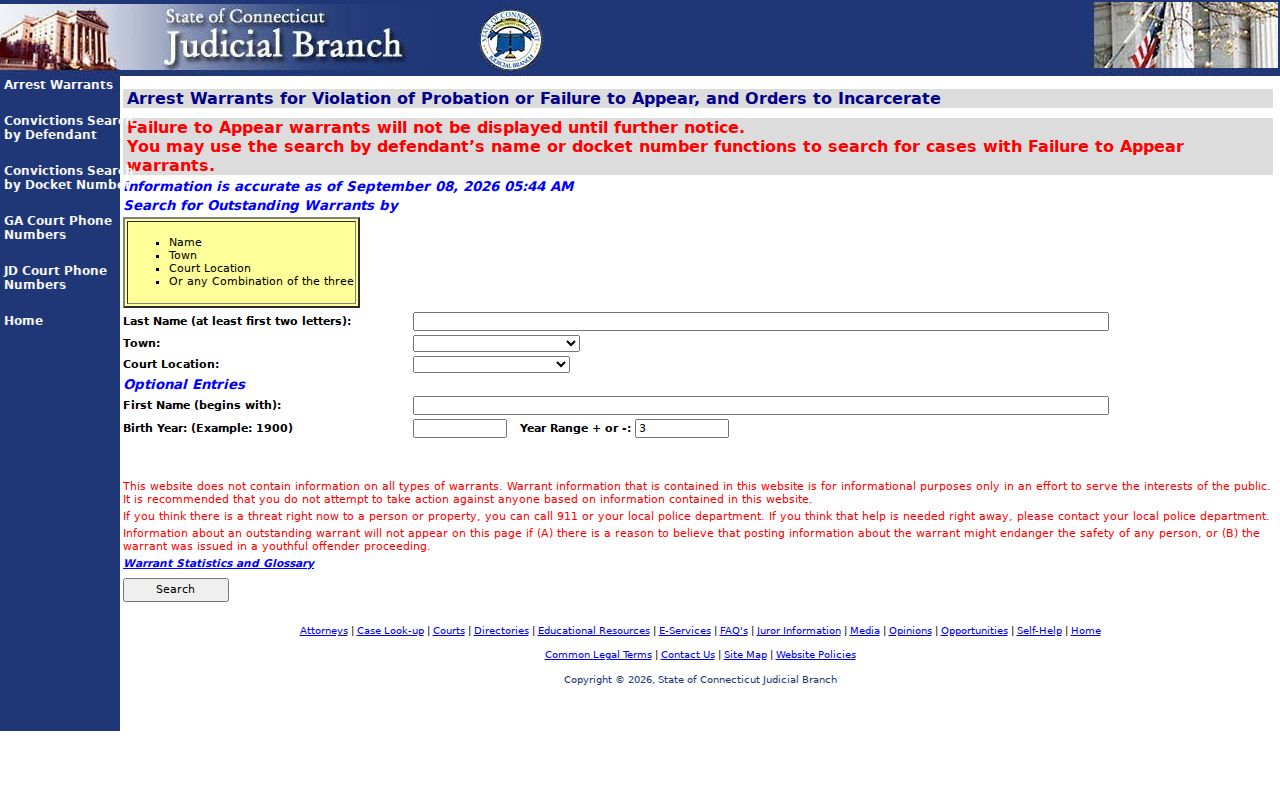
The search fields show why Danbury stays part of a statewide court lookup rather than a stand-alone list. They are interface context only, not a person record, and no filter guarantees every warrant type is visible.
Where to Check Warrants in Danbury
Each source answers a different question about Danbury warrants. The Judicial Branch portal offers a partial name search. Criminal case lookup provides docket data under an accuracy warning. The Superior Court Clerk's Office is the best verification route for a known Danbury docket. Danbury Police keeps local arrest and incident records but posts no complete public warrant roster.
Superior Court Clerk
Known docket, court status, appearance, and routing questions.
203-207-8600
Danbury Police Records
Police-held records and focused Connecticut FOI requests.
203-797-4679
Police Routine Line
Department operational questions, not legal advice.
203-797-4611
Tip 411 is for tips, not status checks. PRAWN and COLLECT are law-enforcement systems with no public login. A sound Danbury lookup keeps those roles separate.
When Danbury Records Need FOI
An FOI request fits when you want a record Danbury Police holds, not an instant warrant status. The Records and Property Division handles incident and arrest records. A focused request should name an incident or CFS number when known, a date range, and the exact material sought, such as an arrest record or a non-sealed warrant application after arrest.
- Name the precise record.
- Give the incident or CFS number.
- Use a narrow date range.
- Keep the response, fee estimate, and redaction notice.
The Connecticut Freedom of Information Act grants access subject to exemptions. It does not turn a request into a live warrant-status query for Danbury records. Court seals, juvenile rules, erased-record law, and investigative limits still apply.
Restricted Warrants and Access Rules
Public access stops where Connecticut law protects a case or investigation. Juvenile records are generally confidential under §46b-124. The portal excludes youthful-offender warrants as well. Sealed affidavits, erased records, protected witness or victim data, and material that could harm an investigation may also be withheld.
Key Rules:
Sealed records do not appear merely because a name is searched.
Juvenile and youthful-offender information has special protection.
A new, agency-requested, or suppressed warrant category may be absent.
Write "no public result located as of the search date." A partial Danbury search does not support saying no warrant exists.
Danbury Status Terms in Context
The Judicial Branch glossary helps decode labels without turning reports into person records. Current Danbury warrant status still comes from the court or responsible agency.
- FTA
- Failure to appear in a criminal, motor-vehicle, or infraction matter.
- VOP
- Violation of probation, a distinct warrant category.
- OTI
- Order to incarcerate, not a synonym for every bench warrant.
- Active
- Issued and not recorded as served or ended in that reporting system.
- PRAWN
- The restricted Paperless Arrest Warrant Network.
Statewide caseload tables count activity, not people. So a row marked Active is not a Danbury warrant roster. It is a workload figure for a period and category, and it says nothing about who has an open warrant.
Danbury Criminal and Civil Paths
A criminal bench warrant and a civil capias are different tools, and Danbury residents run into both. Connecticut state marshals serve civil capiases, often in family-support matters. That duty gives the state marshals no sheriff-style criminal warrant list for Danbury. An arrest log is a separate product again. It reflects arrests a police department publishes by practice, not warrants still open. City constables also do process-service work, but their public page offers no warrant database. Keeping these apart stops a past arrest, a civil order, or a general agency record from being read as a current criminal warrant. When the paper type is unclear, ask which court issued the process and which agency carries it out. The answer tells you whether to call the Superior Court clerk, Danbury Police Records, a family-support office, or a state marshal.