
Checking for a Warrant in Danbury
The Connecticut Judicial Branch public warrant page is the sensible first stop for a warrant search, and it covers selected state warrant categories. It searches by name, town, and court location. Read its warnings closely. Not every warrant type appears there, and failure-to-appear warrants will not display until further notice, the page itself says. Danbury has no sheriff roster to fill the gap. Keep a private note of your date, filters, and result
- Read the state portal's current notice, then search by at least two last-name letters.
- Add first name, birth year, or year range to narrow a common name.
- Use DANBURY as a town filter, or Danbury GA 3 and Danbury JD when the court is known.
- Review the criminal case lookup for a known name or docket.
- Call the Danbury clerk at 203-207-8600 to verify a court-status question.
- Use Danbury Police Records for a focused police document request.
Danbury Has No Sheriff Shortcut
Connecticut has no county government doing local work. Danbury sits inside Fairfield County on paper only. No Fairfield County or Danbury County sheriff exists to publish or serve local warrants. Criminal process flows from Connecticut Superior Court instead. Danbury Police handles city law enforcement, while state judicial marshals guard the courthouses and handle some court functions. That structure reshapes any Danbury warrant search from the first phone call. A known criminal docket question goes to the Superior Court clerk. Arrest and incident records belong to Danbury Police Records. A civil capias may pull in a state marshal or a family-support office. The Danbury Town Clerk keeps municipal records but does not serve as a criminal warrant clerk. Sending your question to the right office the first time spares you a false assurance from a desk that never held the warrant record you need.
Danbury Warrant Types
Warrant is an umbrella word in Danbury. Several kinds of court process fall under it. Triggers, issuing authority, and public access all differ, so knowing the type is step one in any useful warrant lookup.
| Warrant Type | How It Arises | Who Issues It |
|---|---|---|
| Arrest warrant | A finding of probable cause for an alleged offense | Connecticut judge or authorized judicial officer |
| Bench / FTA warrant | A missed required court appearance or other court obligation | Superior Court judge |
| VOP warrant | An alleged violation of probation | Superior Court |
| Search warrant | Probable cause to search a place, person, or item | Judicial authority |
| Civil capias | Civil or family-support enforcement process | Court in the civil process |
A capias is not automatically a criminal Danbury warrant. Connecticut uses capias and capias mittimus in civil and family-support settings too. A search warrant authorizes a search, not a public invitation to track down a person.
Danbury GA3 and JD Roles
Connecticut Superior Court at 146 White Street holds two key Danbury court functions under one roof. Geographical Area No. 3, usually written GA3, takes class C, D, and E felonies, misdemeanors, infractions, and motor-vehicle matters from Danbury and nearby towns. The Danbury Judicial District handles the serious criminal cases and Part A administration. Both are state courts, not City Hall branches. The public search lists Danbury GA 3 and Danbury JD as Court Location choices, but those labels mark where a case lives, not where a person lives. The Judicial District covers Bethel, Brookfield, Danbury, New Fairfield, Newtown, Redding, Ridgefield, and Sherman. So a result tagged Danbury can reach well past the city line.
Local rule: Use a Danbury court filter only when a docket, notice, or clerk confirms the correct court level.
Inside a Danbury Warrant Record
A public result can guide your next call. It cannot expose the whole law-enforcement record. Read every identifier together, then confirm the current status with the issuing court or the agency holding the Danbury warrant.
| Warrant reference | A court or system number, such as official warrant number, if displayed |
|---|---|
| Identity details | Name and limited matching information allowed for public view |
| Allegation or category | The offense, VOP, OTI, FTA, or other displayed classification |
| Issuing court | The court tied to the warrant or docket |
| Bond | Amount or conditions only when authorized for public display |
| Status | A dated system state requiring current verification |
Danbury publishes no universal warrant-number pattern and no local bond schedule. So never reuse a number or bond figure from some other case as a guide to what applies here.
Danbury Public Portal Limits
The public warrant page is partial by design. It does not carry every warrant type. Its September 2026 notice suppressed FTA display and pointed users toward the name and docket case searches. Juvenile and youthful-offender matters follow separate confidentiality rules. A seal, a safety concern, investigative need, a timing gap, or a category line can also keep a record out of view. The criminal case lookup works as a second source, but its own disclaimer says web information is not guaranteed accurate or current and is not the official court record. Treat a blank screen as no public result, not as proof that no warrant exists. A clerk or the responsible agency gives the best current confirmation the disclosure rules allow.
Note: Never confront a person or attempt an arrest based on an online result; call 911 only for an immediate danger.
Issuing and Serving Warrants in Danbury
Courts issue criminal warrants after the required legal finding. Police officers and other authorized law-enforcement personnel then execute arrest warrants. Danbury Police may find an active arrest warrant through ordinary police work, though its press releases and arrest logs are not complete public warrant databases. Judicial marshals run courthouse functions, while state marshals generally serve civil process such as a civil capias.
Superior Court Clerk
Known docket, court-status, appearance, and case-routing questions.
203-207-8600
Danbury Police
Routine police matters and department-specific operational questions.
203-797-4611
DPD Records
Incident, arrest, and other responsive police records.
203-797-4679
Danbury's elected constables handle process service, and that work sits right in city government. Still, their public information offers no warrant lookup, so the office holding the record is what matters.
Danbury Police Records Route
The Danbury Police Records and Property Division holds incident and arrest paperwork, not live warrant status. A Danbury FOI request works best with specifics. Give the incident or CFS number if you have it. Add the date or a short range. Then name exactly what you want, such as an arrest record, an incident report, or a warrant application and affidavit that is not sealed.
- Incident reports: 203-797-4681
- Accident reports: 203-797-4660
- Other records: 203-797-4679
- Records administration: 203-797-4680
Danbury Police Department's older form lists fees for documents and media. The 2023 form carries a newer field layout with no visible fee schedule. Confirm which form the department currently accepts and what it costs, since redactions may shield sealed, juvenile, erased, investigative, victim, or witness material.
If You Have a Warrant in Danbury
Start by learning the court, docket number, warrant type, and the agency holding it. Danbury cases follow different paths. A lawyer can weigh a scheduled court appearance, voluntary surrender, posting bond, or a motion to recall or quash. That motion asks the court to withdraw or set the warrant aside under the applicable procedure. Paying money online does not automatically cancel a warrant, so don't assume it will.
Act with care: Contact counsel before surrender, then confirm the correct location, time, identification, payment method, and release process with the court or responsible agency.
For Danbury court matters, call the clerk at 203-207-8600, bail and pretrial at 203-207-8715, or the Public Defender at 203-207-8650 if eligible. The Court Service Center, 203-207-8766, offers procedural help only. It cannot provide legal representation. Danbury publishes no surrender hours, station bond window, universal bond schedule, or amnesty program.
Danbury Courthouse Travel Context
Danbury Superior Court sits at 146 White Street. The Court Service Center is on the lower level. Walking from Patriot Parking Garage at 21 Delay Street covers about two-tenths of a mile, along Independence Way, then Patriot Drive, then White Street. Confirm parking, hours, and accessibility before you go. Confirm the destination too. The address helps once you hold a Danbury docket. It is not a reason to arrive without advice or notice. Ask the Danbury clerk which division handles the case and what documents to bring. A docket number and identification help staff route the question. City Hall at 155 Deer Hill Avenue is the wrong stop for a Danbury criminal warrant; its Town Clerk handles only genuine municipal-record matters.
Danbury Warrant Records and Public Access
Connecticut law starts from the premise that the public can see most agency records, with narrow exemptions carved out. Courts add their own access rules on top. FOI §1-215 spells out what an arrest record holds and when a non-sealed warrant application and affidavit become public after arrest. None of that opens every active warrant to view in Danbury, since a warrant still in service stays sealed from routine lookup.
Access boundaries:
Connecticut General Statutes §1-210 provides access subject to statutory exemptions.
Section 46b-124 protects juvenile matter records and delinquency information.
Sealed, erased, youthful-offender, investigative, victim, and witness information can remain restricted.
Public case lookup is a service copy, not the official court record.
If a Danbury agency denies or redacts your request, save the written reason and the appeal information that comes with it. Access is a records process. It does not promise instant or complete disclosure.
PRAWN Is Not Public
Connecticut's operational warrant system is the Paperless Arrest Warrant Network. Warrant data flows into a registry and transmits to PRAWN, where authorized criminal-justice agencies pull detail, spot the responsible agency, and process custody information. COLLECT gives justice agencies entry to PRAWN and other systems. None of that extends to a public account for a Danbury resident. The history explains the reach. The state built the system after Public Act 00-209, extended it to municipal police departments in 2005 and state police units in 2007, and now counts more than 140 criminal-justice agencies taking part. That scale is operational, not public. A Danbury warrant question put to an agency can draw on far more than any public portal shows, which is why an official answer often differs from what a public warrant lookup returns.
Danbury Police Station Context
The official Danbury Police page supplied the local station image below.
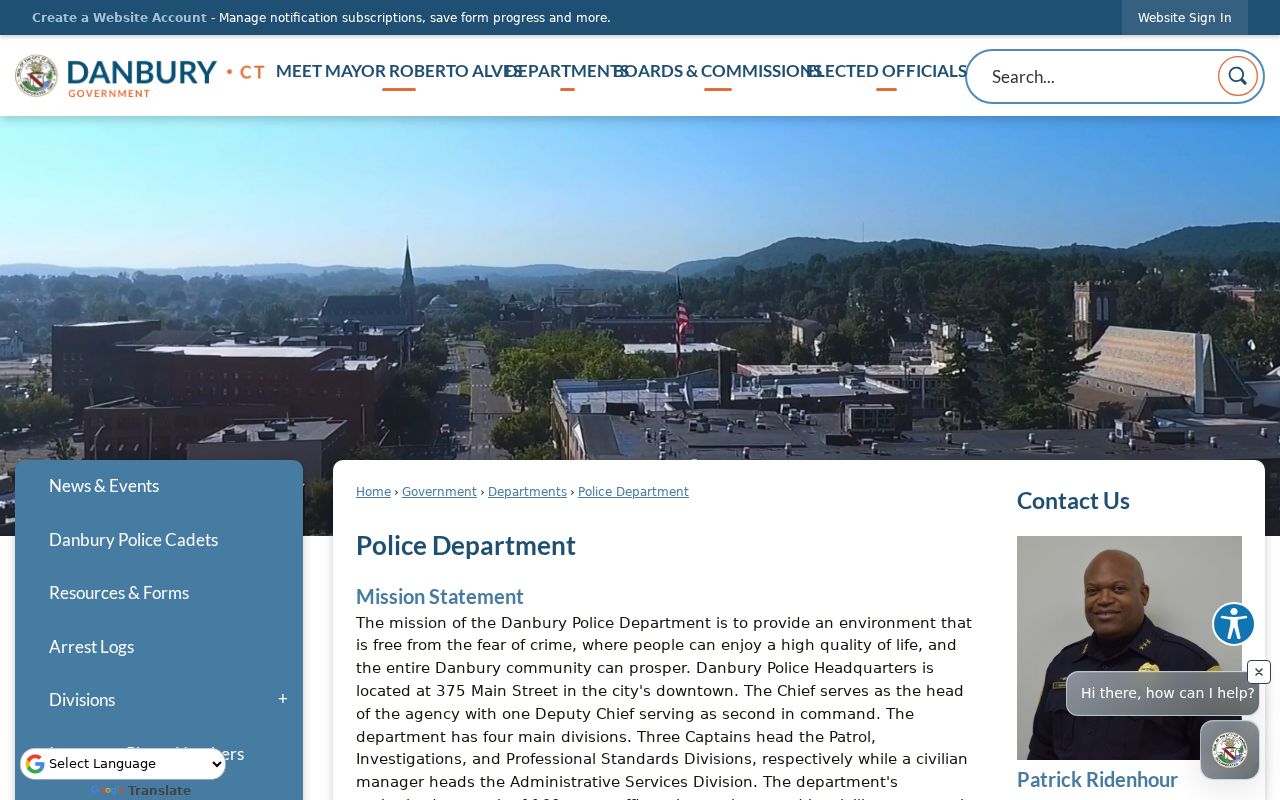
Headquarters at 375 Main Street serves as a police contact and records location in Danbury, not a county sheriff office and not a public warrant roster. Routine police contact, emergency dispatch, and Records Division requests run through separate channels. A private company operates the communications center, the city says, while the department keeps front-window reception. The split is practical. Call 911 for an immediate threat, use the routine line for police operations, and use a records number for documents. Tip 411 takes anonymous information. It cannot confirm a warrant or arrange a surrender, so treat it as a tip line only.
Danbury Reports Need Care
Office of Policy and Management monthly reports and Judicial Branch statistics measure warrant activity in the aggregate. They cannot tell you whether one named person has a current Danbury warrant. OPM itself says it publishes data for reference only and does not issue, enforce, remove, cancel, or change warrants; courts and law enforcement hold those roles. The GA3 motor-vehicle statistics break Danbury workload into categories such as Active, Inactive, Marked for Disposition, Programs, and Rearrest/14-140. Those are case-management labels, not a tally of people with active arrest warrants. The statistics glossary adds a caution: municipal or state law-enforcement-requested warrants do not appear in PRAWN reports the way court warrants do. Read the aggregate sources for system context, nothing more.
Note: Counts from different reports, dates, and categories should never be combined into a person-level or city warrant roster.
Danbury Warrants by City
This project covers a single locality: Danbury, Connecticut. The 2020 Census counted 86,518 residents across about 42 square miles. Geographically the city sits in Fairfield County, but warrant administration splits between local police and the statewide Superior Court system. No other county cities belong on this city-scoped page.
Danbury Warrant Search
Local routes through Danbury Police, Danbury GA3, the Judicial District, and statewide Connecticut record systems.
The locality page keeps the address and agency map side by side. It also explains why a "Danbury court" is a state courthouse, not a municipal criminal court. And it shows why no sheriff shortcut exists.
Danbury Warrant Terms
Plain terms keep different kinds of Danbury records from blurring together. Each label points to a different court process or source.
- Active warrant
- Issued and not recorded as served, vacated, or otherwise ended in the reporting system.
- FTA
- Failure to appear for a required criminal, motor-vehicle, or infraction proceeding.
- VOP
- Violation of probation, a distinct state warrant category.
- OTI
- Order to incarcerate, not a synonym for every bench warrant.
- Recall or quash
- A court action that withdraws or sets aside a warrant under the applicable procedure.
- Civil capias
- Civil process, often related to family support, that must not be mislabeled as every criminal warrant.
“Issued” and “served” mark two different steps. A Danbury warrant is issued when a judge signs it, and served when an officer executes it. Counts of each can cover the same period, so check your own status with the issuing court.